The term ’21st-century learning’ generally refers to core competencies that teachers integrate into lesson plans to help students thrive in today’s world.
BRIEF INTRODUCTION
MULTIDISCIPLINARY AI TOOL FOR EDUCATORS (MAITE) is a Procedural Flow of the lesson plan development platform. The system includes an optional AI Smart Search assistant to help teachers efficiently generate high-quality lesson planning activities towards visualizing the 21st century learning.
A research process on the usability has been conducted, and improvements have been made occasionally to enhance its effectiveness. Verification from local and foreign educational figures as well as from the Center for Curriculum Redesign, US has been made.
THE 21ST CENTURY LEARNING FRAMEWORK
The Four-Dimensional Education, (Fadel, C. Trilling, B. Bialik, M., 2015) http://curriculumredesign.org/our-work/four-dimensional-21st-century-education-learning-competencies-future-2030/ and Education for the Age of AI – Revised version (Center for Curriculum Redesign, 2024) are the 21st century frameworks that have been adapted and integrated in the development of MAITE for teachers to design their lesson plans.
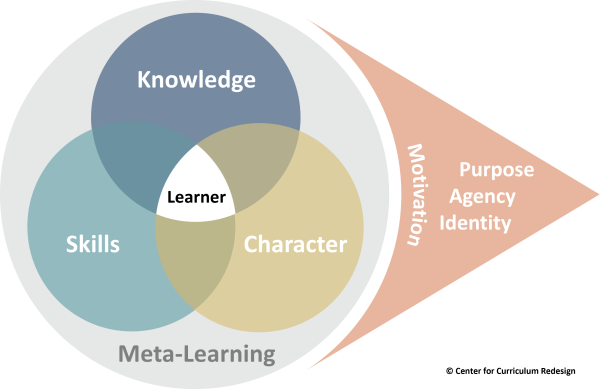
The Four Dimensional Learning encompasses the following dimensions and competencies:
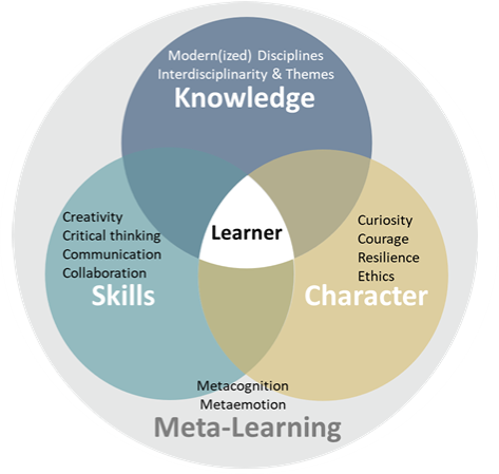
Source: CCR
- Knowledge
- Modernized Disciplines, Interdisciplinary & Themes
- Skills
- Creativity
- Critical Thinking
- Communication
- Collaboration
- Character
- Curiosity
- Courage
- Resilience
- Meta-Learning
- Metacognition
- Metaemotion
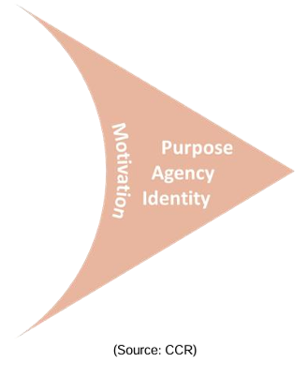
In addition to the goals outlined in the Venn diagram, education must increasingly be personalized. This approach involves four key drivers: Motivation, Identity, Agency, and Purpose. Among these, motivation and purpose are considered quintessentially human:
How do teachers design their instruction—unleash the learners’ potentials and provide opportunities in developing and generating their minds?
The Strategical and systematic learner-centered approaches are required in enhancing and sustaining the quality of education in the 21st century learning through an innovative instructional design tool – MULTIDISCIPLINARY AI TOOL FOR EDUCATORS (MAITE)